AV Review – Marantz AV8805

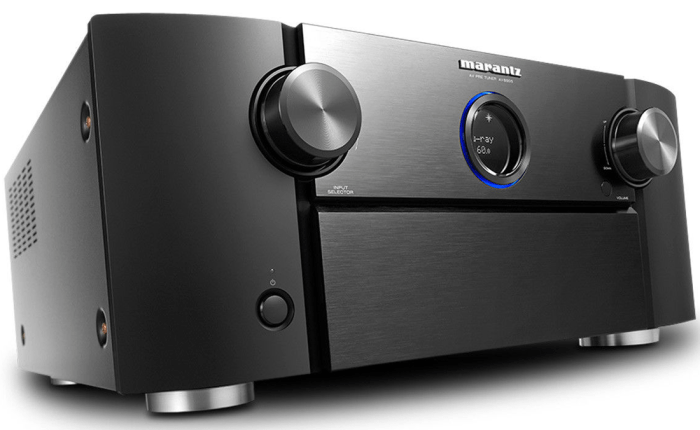
AV Review – Marantz AV8805

So last year I upgraded to a AV8802, and while it was an amazing receiver, it still lacked a few things I had on a wish list in the back of my mind.

One of the major things was when I moved to Atmos, I lost the ability to use my front Height speakers and my Wides.

The unit had only 11.2 hook ups, which in honesty is way more than most, but it still was a sticking point as I had these speakers here that I had not used for over a year now.

So when they announced the AV8805 would have 15.2 hook ups, and 13.2 live signal processing, I was intrigued, but honestly still not 100% sold.

The 8802 had cost a good chunk of change, so I had not real intention to snag the 8805.

Once I started to see the reviews dropping about some of the extras, I was sold hook line and sinker.

One of the biggest upgrades in my eyes was the ability to use the new Audyessy app to configure, calibrate and tweak, and additionally swap back and forth between calibration files.

Now I will preface this with 2 things, one it does not work perfect for everyone.

I personally have not had a single issue with the app, but if you look at the comments and reviews on it, there are a lot of unhappy folks.

My take on it is, a lot of these people are in no way tech savvy at all.

I get that they bought an expensive piece of audio equipment, but that does not mean they know their ass from a hole in the ground when trying to get things in your house networked and talking.

As the primary complaint is connectivity, and that is almost solely dictated by your equipment and know how, it is easy to see that most people having problems have no clue how to use the tech.

But I digress.

Second, and this one really pissed me off. The MutilEQ app is not free. For me in Canada it was $35 (27.99 in the US)

Now I just bought a $6000cdn receiver, seriously, we need to pay another $35 to use it to its fullest?

This is a blatant money grab by Marantz, and one I am rather grossed out by.

Especially since as many folks claim, they have issues with it, and support from what I have read is non-existent.

Major oversight, or colossal FU to the customer, not sure which it is, but either way it leaves a very bad taste in my mouth.

/rant

The application itself is a dream to use. Gone are the days of navigating the menu on the small screen, or relying on the display output to clunkily go through the setup.

Fire up the app, connect to your receiver, and then begin the config.

It is actually really user friendly given what you are doing here.

The prompts all look familiar as it is pretty much the OSD calibration, just in the app.

Once you roll through your setup and get the readings from the 8 locations, the file is saved on the app and ready to go.

What I did not realize out of the gate is you have to actually tell it to upload to your 8805. I was a little surprised that once I was done, and checked the receiver none of the Audyessy stuff was applied.

This part was not really clear in the app.

So once finished, you choose where to send the file, this can also be to external storage like google cloud services and such.

Once things are calibrated, and before you upload, I would highly recommend looking at the post configuration of each speaker and levels.

This is where the tweaker paradise comes in.

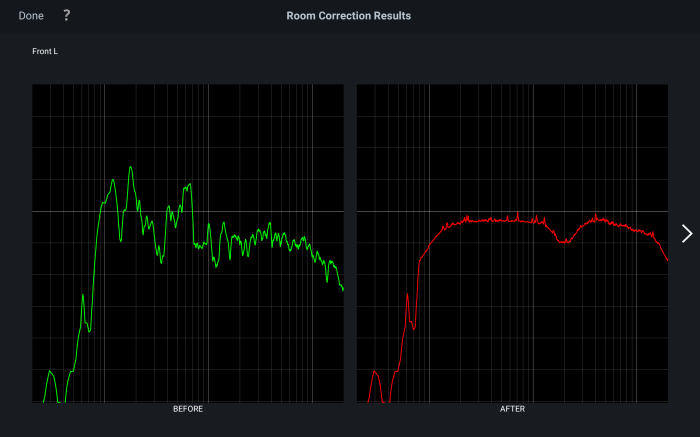
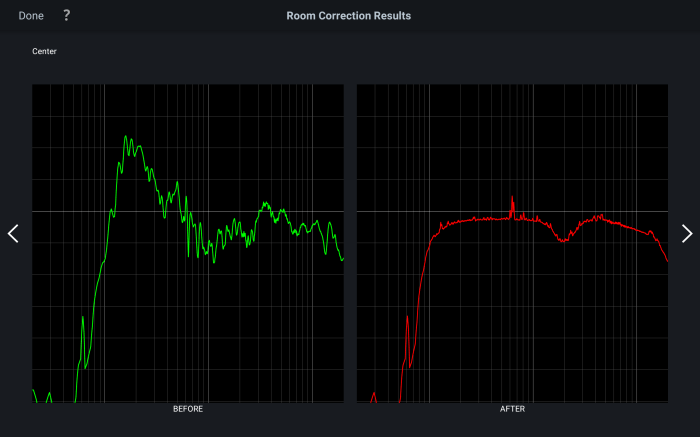
You can go channel by channel and adjust the frequency bumps as you see fit, you can see how well the room correction was applied. And get an overall sense of how good or bad you room is acoustically.

Now I have a fully treated room for 1st reflection point on all speakers. As well as diffusers on the back wall, and bass traps in the back corners.

And as you can see in the pictures below, my well treated room is still a bloody mess.

Here you can see the Front Left Channel, this has total treatment for 1st reflection:
Screenshot_2018-12-15-18-59-05

Here is the Center Channel, should have no reflection here due to location:
Screenshot_2018-12-15-18-59-13

Here we have the dual subs, this is one of the biggest fixes, having dual units is very hard to calibrate yourself, and their placement can be really tough at times.

The Audyssey cleans this up near perfectly:

Screenshot_2018-12-15-18-59-42

Now I do have one major gripe about how the calibration is handled here.

So the way Audyessy works is you set your speakers up, be that 7.1, 11.2, 7.2.6, whatever you please, then you run Audyessy calibration.

The issue is that if anything changes with your speaker config, then you have to do a re-calibration.

So, in the case of the 8805, you can only have 13.2 channels active at one time. So you have a choice to make.

You set it up as say 9.2.4 so it includes your wides and 4 ceiling speakers. Or you set it up as 7.2.6 to include all 6 ceiling speakers and leave the wides out.

There is no way to do a one time, 15.2 speaker calibration.

Now to compensate for this, the app itself allows you to save multiple calibration files. Which kind of saves the day here.

The problem is that should you choose to switch back and forth, it is not a fast task, it can take 5-10 mins to transfer the calibration file to the 8805 from the tablet application.

So, there is no easy A/B test if you are trying to find out what mode sounds best for a particular movie.

Besides that, little oversight on Marantz part, the unit is a dream to own.

There is nothing I have not thrown at it that has not been presented with pure audio and video bliss.

I primarily use my theater for gaming. I would say it is about 80% gaming, 10% movies, 10% tv.

When it comes to games things both look and sound phenomenal.

I run in Dolby + Surround mode 90% of the time, to allow for a faux Atmos processing to be done. Throwing sound to the ceiling channels in some games sounds incredible.

Your room goes from being 2d to 3d in a click.

With games like Destiny 2 the upper level comes alive, ships flying over, bullets overhead, etc.

There are a few instances where this does not work well though.

As this is just emulating Atmos, and it is only an approximation, things can get thrown to the ceiling that should not.

For instance, in Destiny 2, some of the NPC characters in the Tower when positioned behind you, will en up om the rear ceiling channel shouting down at you.

But all in all, I see the benefit more so than the annoyance, more often than not it sounds great.

When it comes to movies though, things are outstanding.

Movies like Logan, the forest scene feels like you are right there, the wind rushing through the trees above you, the room is just alive.

I have yet to watch a movie that has not been enhanced by having all 6 channels overhead active.

Video has presented no hiccups either. With full 4k 4:4:4 pass-through I have not had a single handshake issue to day.

I have run it through the paces with 3d, 4k and SD and it all comes through just fine.

Unfortunately, I cannot speak to the advance media features though. The unit has tons of options for streaming services, AirPlay, Bluetooth, Pandora, Spotify, SiriusXM, Amazon Prime Music, TIDAL.

None of which I sue as I have a HTPC hooked up.

Other features include full HEOS support, so you can do direct voice control for the unit if you wish via Amazon Alexa or Google Assist.

This really is the Swiss army knife of receivers.

While this is definitely one of the more expensive receivers on the market, it is hands down the most robust, sure you can look to some higher end AV manufacturers, you would however be hard pressed to find another unit out there that provides all the bells and whistles the Marantz 8805 has.

In upgrading to the 8805 I also took the opportunity to switch over my amplifiers for a couple reasons.

I used to be a 100% Rotel guy, for a good 8 years all my equipment was Rotel, that is until they did not keep up with tech and were way out of date on their receivers, that is ultimately what drove me to Marantz.

So over the years I have been toying with picking up a pair of MM7055’s and a MM8077.

This would allow me to move away from my dual RMB-1095’s and my RMB-1090 2 channel amp.

Part of the move was due to the place I am at now with my usage and listening.

When I bought the amps way back in 2002 I was using my system for 50-60% music. SO 2 channel was king for me.

The 1095 offered 350w per channel and my Def Tech BP2000TL speakers were made for being driven VERY hard.

So the need was there.

As years past, and music became way less important, to me, and movies and gaming took the front stage. It no longer made sense to have these seriously over powered amps. They were overkill, and additionally they were huge power sucks.

So when one of my Rotel RMB-1095s started acting flaky a couple years ago, I grabbed a MM7055 demo unit from Best buy for a steal.

Since then I have been toying with the idea of going full Marantz.

And I can safely say I am glad I did.

The clarity of the amps and 150 and 140 wpc is fantastic. The sound is warm and right, and dialog through my center channel sounds even cleaner to my ears than the old 1095 produced.

So now my Rotel days are behind me and my future with Marantz is looking very very bright!

One last thing I want to mention about the 8805. Some of you may be concerned about future-proofing with the new HDMI 2.1 format on the horizon.

Well Marantz has officially committed to having the ability to upgrade this receiver when the time comes. It will be a paid upgrade, at a marginal cost, or so they say.

The unit would need to be sent to Marantz as it is a major update and not just a board swap, and they say it is expected to be available sometime in 2020 once the 2.1 spec has been finalized.

If you are a movie buff or game enthusiast like I am with a big enough dedicated space to accommodate a full theater, you own it to your ears to pick up one of these receivers.

You will not be disappointed in the least.

A solid 10/10 and one of the best pieces of audio equipment I have ever owned.

PS4 Review – Unravel 2 – the sequel we didn’t know we needed (and may not)

PS4 Review – Unravel 2 – the sequel we didn’t know we needed (and may not)

So this year at the EA press conference at E3, we got a sudden surprise.

A stand out indie title from 2017 was magically getting a sequel, and surprise, it was due out the day of the announcement.

This was met with a bit of mixed emotions.

Unravel 1 was a real stand out game, a passion project by its creator, to tell a story of loss and love, a tale of missed opportunities and connections to one another.

So when we got a sequel out of left field, to a game that really said all it needed to, it was a little odd.

Unravel 2 is a mixed bag.

The heart and soul from the first game are gone, which I cannot help but feel is EA’s doing, now just rah rah EA sucks, but it definitely has a commercialize feel to it that was not in the first one, where pt 1 was so intimate and feeling.

Part 2 is just polished and sterile.

Now does that make it a bad game?

No not at all, it is just a different game. And should be approached as such.

Not so much a sequel, and just another new game.

This time around Yarnie has a new buddy. A mirror image of himself in a different color (of which can be completely customized this time)

So for one, the game can be played entirely co-op on the couch.

Best I can tell the overlying story is about 2 friends or brothers and their attempt to run away from something or someone bad. Hard to tell really as the story is a lot more disjointed than the first game.

The puzzles though and level traversal are top notch.

They all factor in the 2 players, or trickily single player in my case.

Where you have to really step back and think though some puzzles portions.

Even though it could be 100% solo friendly, I sincerely think the experience would have been much better with a partner.

You essentially meld your two characters together to continue as one until you have a time to pop apart and solve a puzzle. This can be a real pain, something as simple as one Yarine standing on a switch and the other bouncing up to grab a ledge gets a little tricky.

It would have been a simple maneuver as a pair, but solo you are fast switching characters to try to make it work.

It all worked out in the end, and provided a fun Saturday afternoon, clocking in at about 4 hours it is a perfect cold winter day game to blast through on a single day.

The sound in this game caught me by surprise, it was MUCH better than expected. The environmental effects sounded amazing in simulated Atmos. The rain, the wind, the whole ceiling was alive with ambient noise.

Visually though, I think the first game came across as a better look and fit. Again, this game had some big developer clout behind it, and that organic, earthy feel of part one was gone here, in a trade off of polish, that took that “real” feeling out of the world.

All in all a fun game, not as good as the first, but still a fun game to play.

A decent 7/10 and a recommendation for any couch co-op fans out there.

PSVR Review – Astro Bot Rescue – It’s a ME, ASTRO BOT!

PSVR Review – Astro Bot Rescue – It’s a ME, ASTRO BOT!

So if Astro Bot Rescue has taught me anything, it is that I sincerely wish that Nintendo would throw its hat into the VR arena.

Astro Bot Rescue is in every single way a perfect game, a 10/10, no questions asked.

It feels like a direct sequel to Mario 64 mixed with Super Mario Galaxy all rolled into a perfect package.

There is so many elements ripped right from the pages of Nintendo I am stunned they are not getting sued.

To date, we have not had a more polished and visually stunning VR game. Many have tried, and even amazing stand outs like Resident Evil 7 all suffer from the low res blues that is common with so many VR games.

Bland textures, grainy darkness, and horrible edges that look like teeth on a chainsaw.

Next to none of that is present in in ABR.

All 5 in game worlds are unique, and offer typical Mario like experiences. From ice worlds, under water levels, to the final worlds lava filled jump fest. It is all here in spades, and all works so bloody perfectly.

The controls are a perfect mix of both traditional 3rd person platforming, and a mix of VR touches from using your head to break barricades and kill enemies, to your controller becoming a Swiss army knife of tools.

It is worth mentioning too, that controller integration in Astro Bot is the best I have ever seen in VR.

Each level you “snap” your controller to a mold on screen, and it is rendered just like your DS3 controller in you hands, except all shiny and with glowing buttons.

You see the sticks move in VR 1 to 1. Same for button presses.

As you rescue your little stranded robot buddies, they fly around the screen and ultimately land and reside in your controller.

It is a real cool sight to behold.

The gadgets you acquire too are very well designed, from throwing stars you throw by sliding your hand over the touch pad, to a water cannon that is used to grow flowers or put out fire enemies.

Traveling through the 5 worlds that encompass 20 levels, and 5 boss fights was pure joy.

I could not wait to get to the next level to see what they had come up with.

The water levels we so incredibly well crafted and the fluid effects were just stunning.

And the boss fights themselves had an amazing sense of scale and depth. Be it fighting a giant King Kong like gorilla, or a shark the size of a Megalodon.

Sound presentation was outstanding as well, with a soundtrack that has been stuck in my head for days, to the sound of your rescued buddies flying overhead and behind you, it truly shines in simulated Atmos.

For the collector out there, there is a ton to do as well.

You have 8 robots to rescue spread over 20 levels. A hidden chameleon in each of those 20 levels, which unlocks a bonus challenge stage per each reptile.

As well there is a play area in which you can spend your coins in a claw game machine to unlock collectable statues (over 110). But it goes farther than that.

In the play areas you can go to each of the world from the claw games collections, and the items you collect will appear as interactive play toys.

So you are pretty much collecting things to build your play world.

Lastly is the challenge levels. 20 in total, that consist of a pile of short games spread over the 20 levels from the game. From timed races to gadget challenges to redoing the boss fights with a perfect goal in mind. All garnering you another 2 rescued bots each.

My only negative about Astro Bot is it was over in a heartbeat.

While clocking in at about 6 hours, it was still too short and I wish there was 50 more levels to play.

I hope Sony uses this success of ABR to spin up a new VR franchise, because I could see myself playing Astro Bot for a lot of years to come if they do.

An amazing 10/10 and a 100% must own for all PSVR users. You will not be sorry.

PSVR Review – Light Tracer

PSVR Review – Light Tracer

Back into the land of the virtual.

A long time ago I snagged Light Tracer, back when I owned PSVR for the first time (yes, I stupidly sold it) but never got around to playing it, and had written it off as I no longer had a PSVR.

So I figured may as well blow off the digital dust and dive into this little gem.

Light Tracer is a MC Escher like puzzle game, where by you girl a little princess up a tower (no so unlike the tower of Babel) to the gods residing at the top, in an attempt to save her people from a sickness that put them all into a slumber.

This plays out over 8 levels and about 5 hours of playtime.

The game is both fantastically designed, and a frustrating mess all at once.

The concept was solid, the world itself is made from floating platforms that continue to ascend. It can be turned and manipulated with the left wand, and some items can be pulled, or moved with the same hand.

This works about 70% of the time.

As there is no real sense to the rotation of the level, it can sometimes be frustrating to get the camera in the right place so you an continue or make a jump.

This frustration can be compounded by the fact that the princess is not super responsive.

She is essentially a cat (not literally) that follows you laser pointer from the wand in your right hand. You point a beam of light and pull the T trigger, and she will approach follow the pointer.

This is terribly frustrating at times when you angle is just slightly off, or you lose tracking, and on a key jump she plummets to her death.

This will happen about 200 – 300 times in your play-through.

Now that is not a total bad thing, the game would have been a cake walk outside of VR, but the unique puzzle and angle ideas really worked well in VR.

Just go in knowing you will be cursing under your breath sometimes.

The story itself is kinda cool, nothing ground breaking, and it plays out in between level cut scenes.

It came to a surprising and satisfying conclusion.

And speaking of which, after the game is over, you are shockingly treated to a trailer for the sequel, a game literally no one is talking about. It looked reeeeeeealy rough, but it was nice to know they are moving away from this to a more traditional 3rd person adventure game.

No clue when it is coming or how far along it is.

All in all a fun little weekend romp, I would recommend it to anyone looking for more puzzle games in VR.

A decent 7/10

PS4 Review – FE, ironing out the kinks….

PS4 Review – FE, ironing out the kinks….

So I stepped out of VR for a bit of a brain break and ran through FE last weekend. AS much as I love VR, a man can only take so much in one week.

I had a lot of initial reservations about the game when it came out earlier this year.

Reviews panned it for terrible controls and game play, and I had decided I was going to skip it entirely based on that aspect, as nothing ruins a game for me faster than shoddy controls.

I will tolerate plot holes, shitty graphics, and a myriad  of other issues in a game, but if you give me bad controls you are dead to me.

But this past black Friday FE was marked down to just a few bucks. So I figured even if it is dismal, I can just delete it.

Well color me surprised when it turned out to be MUCH better than I expected.

The game itself revolves around a small woodland creature, it is kinda a mix of a wolf pup and a squirrel for lack of a better description.

You set out on an adventure to save the forest you inhabit from these evil entities hell bent on enslaving all the woodland creatures.

The kicker is, unlike some Disney movie, you cannot actually communicate with them.

You speak squirrel thing, and they speak, bird, or wolf, or elk, etc.

So once you complete a series of tasks to help these creatures, like recovering eggs for the mama bird from said evil creatures, you learn their language.

Thus opening up the abilities in the game.

Once you speak bird, you can talk to the lesser birds and have them fly you all over the game. Or you can commune with some plants to have them open up and give you a seed to throw at enemies.

All of the 6 languages play out this way, each with its own realm and ability to learn that will help you through the world.

It is a solid idea that plays out rather nicely.

The story itself is a little hard to eek out, as it plays out mostly through cave paintings and flash backs found in hidden (and some obvious) stones that put you into the eyes of the evil creatures.

Truth be told, like many indie games, I had to head online to get an explanation to what I just played (one of my major gripes with indie games in general)

It was a heart warming little trip that lasted about 4 hours. But all in all was satisfying front to back.

One thins I will address is the controls.

I can see how some reviews slammed them, but I think that was honestly shoddy journalism.

The controls are different, but never did I find them painful.

Once example I will give is tree climbing, in most traditional games when you latch onto an object to climb it, you move the stick forward to traverse it.

Well in FE once you “stick” to a tree, each press of the jump button moves you up, and when you are on the top, if you press jump again, you jump off.

This is a bit annoying for about 2 mins, til you realize you cannot just hammer jump like crazy. You have to practice a little restraint.

Little gameplay quirks like this is what in my eyes sets FE apart from all the other 3d platform clones out there.

Sound and visual were every nice as well, looking fantastic on the JVC projector. Inky blacks in the forest and shadow detail really pop since my nre calibration.

Sound was amazing too in simulated Atmos, with the wind and environment of the forest coming alive up above.

All in all a great package and a fun game for a quite afternoon.

A reasonable 7/10

PSVR Review – The Inpatient – Avoid at all costs!

PSVR Review – The Inpatient – Avoid at all costs!

So moving down the PSVR road we have Inpatient.

Lets get this out of the way right off the bat.

DO NOT PLAY THE INPATIENT!

Why?

Is it too scary? Nope

Is it too hard to take in VR? Nope

Is it a steaming pile of crap? DING DING DING, give the man a prize.

Warning, I am going to completely spoil the game here, so you dear reader, will not have to endure the torture that it is.

The game had such a solid foundation, it is about the events that preceded Until Dawn (one of my favorite horror games of all time) and was by the original developers (Supermassive Games) and was somehow completely bungled.

My best guess how is that like so many developers, indie and AAA alike, they have no concept of how to make a game in VR.

We are stepping back to the 80’s here in the floundering days of Nintendo and story telling in games.

The game like its predecessor has multiple branching decisions that will lead to 4 different endings.

What it does suffer from though is a completely lousy path to those decisions.

You start off strapped to a chair (in an obvious attempt to capture the restrained feeling of the Resident Evil “Kitchen” demo) whereby you are asked some questions that really lead nowhere.

Trying to regain you memory after some trauma. None of which ever becomes clear start to finish.

It is eluded to you are a Dr, but there is no proof of it.

The game plays out primarily with you locked in a room with you new roommate. Who is also maybe a Dr.

All in all it was hard to tell. Events happen outside the room whereby a bunch of miners turn into Wendigo, and start killing all the staff and patients alike.

How did this happen?

Who knows, it is never explained.

Your door just magically opens one day after what is about 1 week in game, you cell mate, now completely insane, just vanishes, only to show up later in the game perfectly healthy and fine.

Was it all a dream? Was she there? No bloody clue, because IT IS NOT EXPLAINED.

Are you getting a theme here?

That is In Patient in a nutshell.

Lots of small jarring conversation and events, that lead nowhere and have no context or sense to them.

Short of the Blackwell Hospital, and the Wendigo, there is ZERO ties to Until Dawn.

Or so I though.

Apparently if you do a super human series of events, make all the right conversation choices, then you get a special ending, whereby you finish the game as a Wendigo, ultimately finding out you turned into the Wendigo that attacked Beth and her friend encounter at the start of Until Dawn.

What do you get with just normal choices?

A slow ass gondola ride down the mountain, then credits. No wrap up, no “OMG we made it” moment, just a trip in silence and an elation that this turd of a game was over.

Now for the controls.

They were typical VR fare, where you have the ability to go full free rotation (my preference), the issue was primarily with controller detection. I constantly could not grab things I had to in the game, with my “hands” popping around and out of place. Trying to push buttons or turn knobs became a huge chore.

Another major issue was the pacing. This being a walking sim, you had to walk slow like molasses behind NPCs. Now I get pacing in a game, but this seemed like an intentional slog just to garner more time in the game.

The only positive I can offer here is it was over damn fast, lasing only about 2 hours total. Thankfully this was not a 8 hr game to endure.

I sincerely wish The Inpatient was a better game, because its roots were so damn strong.

But instead we have this me too approach to VR where companies feel they can just pop out any piece of crap and we will buy it.

Sadly I did, and the only bright spot here is I get to sell it used to some other sucker.

A dismal 1/10, and I do not recommend any of you play this. Go watch a Youtube video of the playthrough if you are a sucker for punishment.

PSVR Review – Moss

PSVR Review – Moss

So, furthering my deep dive back into VR I checked out the critically acclaimed PSVR game Moss.

This was one of the more refreshing titles I have played in VR.

The attention to detail in the world is outstanding. From the leaves on the trees to the dust particles in the air, you can see that Moss was made with love.

The story narrative plays out via a narrator of a story book, with you in a dusty old library, and a magical book telling of an adventurous little mouse on a quest to save her family.

At the core Moss is an environment puzzle game, solving rather simple puzzle (and a few tricky ones) to go further on your quest.

The entire package is very well crafted, and the story (while WAY too short) actually had me crying out for our little heroine victories.

The controls are spot on and out little heroine with sword and doge combat playing a significant role.

I never felt like I was fighting the controls to move along.

The only small gripe I do have is with VR in general on the PS4. This happens in a lot of games.

The game often seems to assume all us players are just hovering over our sofas. The healing mechanic in the game revolves around you reaching down and putting you hand on your little mouse. Well often times this was below my seat.

I eventually had to re-calibrate, move my camera back, and sit on the edge of the sofa instead of reclined so my hands go down father than my lap.

Now this did not happen often, but it did happen enough to irk me.

As mentioned early, Moss is not particularly long, clocking in at about 3-4 hours, it was over just as the story was starting it seemed. You feel part of a much bigger world (no surprise, you are a mouse after all) but the overlying tale seems pretty great, it is just unfortunate that things end just when you want more.

Guess it is better to keep people wanting than to end on a low note.

This is a must own title for PSVR (or PC VR). It truly showcases just how awesome VR can be when done correctly.

A solid 8.5 / 10.

PSVR Review – Transference

PSVR Review – Transference

So I am taking another dive into VR right now and blowing through a handful of games I snagged recently during the PSVR anniversary sale.

First on the roster is Transference.

I first saw a trailer for this in a stage demo last year during E3. Elijah Wood (of LOTR fame) was backing the project and involved in the development.

This game me a little hope that this game may be something different. With Big Hollywood involved in an indie game, maybe it would be something special.

Well sadly I am there to say, it was not special in any way shape or form.

It totally missed the mark for me.


I found it suffered from Indie game syndrome. Whereby someone who does not really know how to write a solid narrative sprinkle some interesting concepts around that never really gel and the story is not fleshed out unless you look under every rock or go online and try to figure out WTF you just played.


Now I will preface this with a warning. I am going to completely spoil this games story, so be wary.


This is Transference in a nutshell.


The game plays out with you in a presumably virtual world, having downloaded your “mind” into a computer, so you and your wife and child could live forever as a unit.


The concept is strong, but the game itself plays out in disjointed perspectives and family member “worlds”


It all takes place in your apartment in Boston I believe, and you roam around in a walking sim in the same apartment from 3 different “brain” dumps.


Now the main issue is, nothing makes sense front to back.


Your backstory and family interaction play out by finding old video tapes and cds that will show you a FMV video recording of certain events, from a birthday party, to you as a mad scientist.


This is all well and good, but none of it made any sense. You were a dysfunctional family, and you tried to get all of you together to live on forever in “VR” essentially.


But Why?


None of it was explained.


Your kid was not dying, your wife was healthy and sane, so there was no reason I could find that would explain why they did this.


Coupled with the fact that you pretty much had to be put on ice, literally, to stop brain function long enough for a mental snapshot to be taken.


So you would have had to pretty much bring your family to the bring of death to brain dump them.


The game itself shows you pretty much ghosts of your wife and kid and how they are “trapped” in this VR world, your child being terrified as he cannot find his parents, and your wife crushed by depression because you have not showed up.


Your purpose I thought was to reunite all of you as a family.


But nope, after 2 hours of walking around, you find 4 crystals that do… something? And then the game ends and you get a final video of you talking to you.


No family reunion, no payoff, just Meh… then credits.


What a waste of 2 hours.


The best thing I can say about the story was at least it ended quickly.


Also in true VR style, they resort to a few non-sensical jump scare.


There is some 8 bit looking monster that will charge you if you go into the dark.


Why is it here? What is it? None of that is explained, just some ominous dark force that kills you if you stray from the path pretty much.


From a VR perspective I found it frustrating on a technical level as well.


The speed for smooth turning (my preferred method) was WAAAAY too fast, even at the slowest speed in the options menu, it was nausea inducing, and I have a strong VR stomach.


You would whip around faster than a turn in a FPS like Call of Duty. Totally jarring in VR, even with brain hacks.


Additionally I found that item placement was a pain in the ass at times. Where clickable item were too low for standing mode, and too high when crouched.


So when sitting you had to bend way forward to maybe get lucky enough to be able to click a drawer to open. Or if you crouched, the draw was face level, but you could not see the contents as you were too low.


All in all, this was a terrible game. And if this is what we can expect when actors get involved in games, then please guys, stay on the big screen and let the real game devs tackle VR stories.


A horrendous 1/10 and I do not recommend it to anyone under any circumstance.

PS4 Review – Shadow of the Tomb Raider

PS4 Review – Shadow of the Tomb Raider

When Lara Croft came back on the scene in 2013 in the Tomb Riader reboot it took the gaming world by storm.

We got to see a venerable young girl marooned on an island, and the events that started to shape her into the Tomb Raiding woman she became.

It was a title about growth, about survival and about family. You felt like you had to protect her, keep her safe.

Well 5 years later, and now Lara is a full grown woman, and no longer needs protecting, if anything she may need a bit of counseling to help her get over the murdering predator she has become.

Now before I get into the review, there is one thing I did that made Shadow an infinitely better game. The developer added in something I have never seen in a game before.

3 levels of difficulty sliders.

You have one for combat, one for environment and one for puzzles.

What these do if pretty slick. The environmental slide will turn off hints of when to press X button or whatever, but more importantly it turns off the traversal highlights present in so many of today’s games.

Gone are the white painted lines along the path you need to climb. Instead you have to logically look over the area you are in and find the path to travel. This adds way more fun and challenge to the game.

On top of that the puzzle slider turns of Lara’s dialog to help you along. There are no tips for how to solve environmental puzzles, no hand holding at all. Which is a welcome change as well, as it seems most modern adventure games pretty much let you turn on autopilot and just go through the motions.

Sadly though Shadow of the Tomb Raider is a mixed bag.

On the surface, you have one of the best adventure games ever made with the new difficulty mode. But below that you have a bit of a technical mess with a terribly disjointed and at times nonsensical story.

The combat here is completely geared towards stealth and bow use. So much so tha tthe gun combat feels terrible. The aiming is slow, the bullets do not do enough damage, and the ammo is almost non-existent in the game.

You can totally tell the developers wanted you to sneak around and snipe people with the bow, but someone higher up insisted they put in other weapons.

When you play the game like they force you to do, it is damn good, but as with all stealthy games, make one mistake and all hell breaks loose, and in this case, you almost always die due to bad combat mechanics.

The stealth thankfully is very good though. You can cover yourself in mud to hid in the bushes better and not be seen by infra-red googled enemies.

You can punch from trees like a panther, or string up your enemies in tress like a spider.

It is a great system when it works.

The real mess though comes with the story, or really how it is presented. I will give you a non-spoiler idea of one terrible spot.

After a level you meet up with your 2 companions just as a helicopter is leaving damaged, Lara comments she is going to chase after it. She turns to run down the mountainside, and just as she does, as lava and mudslide come crashing down the mountain behind her. She rushes through a village that is getting wiped out, coming to a crashing conclusion as she dives off a waterfall. Where he friend from the top of the mountain picks her up in a boat.

Well…. Your “friend” that you ran away from 10kms away would have been covered in lava and mud as the slide was 5 ft behind you when you set chase to the chopper. And somehow, he magically teleports down to a boat.

It is as if Edios had these great action set pieces they wanted to show off, but had no clue how to include them organically.

Tomb Raider and Rise of the Tomb Raider did a great job of this, but then again those games were much more solo. This title keeps you friend in tow for a lot of the game, him showing up at the end of tombs and villages to add some humanity to Lara.

But in reality he is this magical pawn that can jump anyone on the chessboard and never get hurt, just to further the plot.

All things taken into account, Shadow of the Tomb Raider was a good game, but it had the potential of being a truly great game.

The puzzles and traversal were the best I have seen this generation, but the story presentation and technical issues mar an otherwise perfect title.

An unfortunate 7/10. A must play for fans of the series, but newcomers may be let down by the jarring stroy and the odd plot devices.

PS4 Review – Knack 2

PS4 Review – Knack 2

So when the PS4 launched in 2013 one of the little looked over gems was Knack. In true new console form, there is always one or two games that are a new IP, and seem to show off the new tech, all the while being thoroughly mediocre.

Knack however bucked that norm and turned out to be a bit of a cult classic. Looking like a Pixar movie certainly helped.

And while the game never sold stellar, it did however sell enough to warrant a sequel.

Enter Knack 2, a bigger, bolder and better title all around.

Now to jump in to Knack 2 you really should check out the first one, as the game assumes you know all about Knack and his merry band of human companions. So the story may seem a little jarring to a newcomer as there is no introductions to characters or origins to Knack.

At the core of Knack 2 it a brawler meets platformed, but with a twist.

Knack can take on little pieces of ancient rocks and such and grow bigger and bigger, from the size of a small dog, to a 30ft tall behemoth.

This allows for some really robust game-play changes throughout.

The levels do not all start small and end big as it is directly tied to the pickups you are given, so some levels they may push for a titan like battle with a massive Knack, and others keeping him tiny and having to stealthily sneak through levels.

In addition to this, you have various types of “coating” cor Knack, from metal which will make you super strong, to prismatic glass which makes you die in a single hit, but able to pass through laser grids.

You can really tell this is a passion project for the creators, as there is a lot of little detail and a whole lot of love in how Knack is presented.

The platforming side of things is sadly where the game can fall a little flat.

Level traversal can be a little less than stellar, especially the larger Knack gets, ge can slip off of platforms, miss entirely sometimes, just a few minor annoyances that should have been smoothed out.

Some of these can me mitigated a bit by the skills you unlock, one being the ability to not die when you miss a jump, instead it just pops you back up to the last platform you jumped from.

It seems like this was the devs way of acknowledging the issue, without fixing it.

A decent 7/10 and all in all Knack is a great family game that you can play with the kids via couch co-op if you like.